

The Fang: Interview with Death Worker and Co-Founder of Madison Death Collective, Meghan Johnson
[Busy Witch #15]

A Note From Busy Witch
Happy Valentine’s Day! 🖤
To celebrate love, we will be talking a little bit about death. Fitting, right?

Sink your teeth into these witchy works.
This week: An interview with Meghan Johnson, co-founder of Madison Death Collective.
I first started following Madison Death Collective on Instagram many months ago. Their posts spoke to me, as having a grandfather in Hospice has not been easy. He raised me more than my own father did. Every day, he was there after school to talk to, to laugh with, and sometimes, to cry with.
Losing him would be hard for me, and preparing for the loss felt mandatory. I started looking forward to their posts and stories about grief and the beauty that can be found when coping with death.
When I reached out to Meghan Johnson, co-founder of Madison Death Collective, I wasn’t surprised at all by her kindness and openness. Talking with her was so comfortable, even though we had never spoken before.
Our interview was in December 2024. Meghan had just hosted the first Weave & Grieve, a community event centered on grief and crafting. Now, she’s hosted many more events and made an even deeper impact on her community. I’m excited to share this talk so even more people can understand her artistic and spiritual journey of coming to death work, and how death work benefits all communities.
Busy Witch: My first question is the elevator pitch question. Can you tell me about yourself, your name, where you're from, and how you define yourself and what you do?
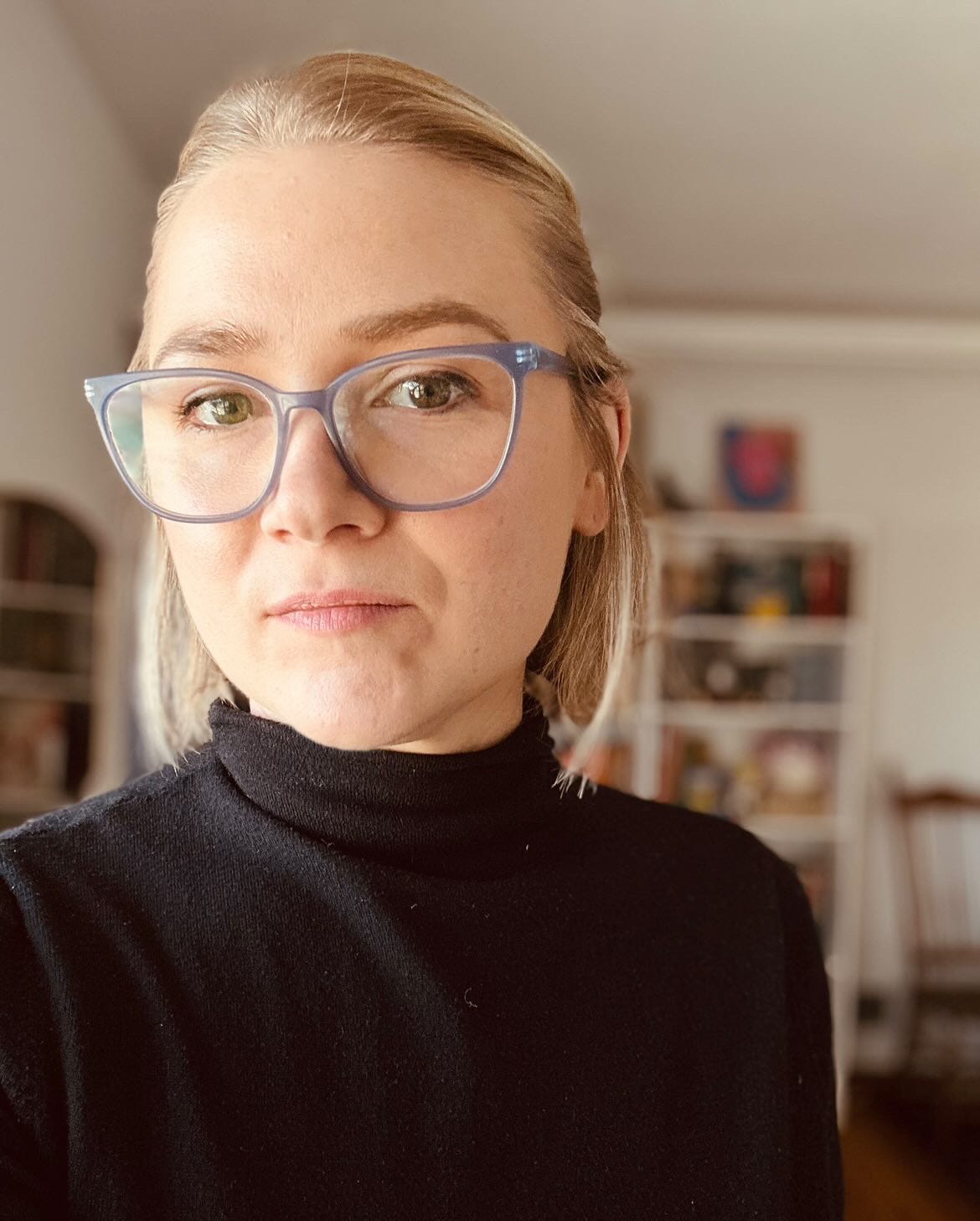
Meghan Johnson: My name is Meghan Johnson. I am originally from Madison, Wisconsin. I just moved back here two years ago after being away for 12 years. And I had lived in St. Louis first, and then New York City for 10 years.
Back in Madison, my background is I'm an artist. I have an MFA in Fine Arts. I'm a stop-motion animation artist. In New York, I was running an art gallery, supporting artists from South Africa and the global South, and promoting them through the gallery in Chelsea. Then I also worked in the animation department at the School of Visual Arts there in New York. So that's my background as an artist, promoting, and just being part of that creative community.
While I was living there in New York, both of my parents died back to back a year and a half apart from each other. I was 33 when my dad died, and I was 35 when my mom died. I was flying back and forth from New York to Madison just before they died to support them while they were terminally ill. My dad had dementia, and he was suffering with a lot of the decline for about six years before he passed away.
So I was in my 20s when that started. Then my mom had breast cancer for 10 years before she died. It had gone into remission and then came back. So I was a 20s, early 30s, young adult, trying to make this career in my life and also working out having terminally ill parents.
At the time, I was trying to figure out resources for somebody like myself who's younger and also caregiving for being parents. And it was really hard. I was googling, I was following things on Instagram, but there wasn't really that much back then.
I hadn't stumbled upon the term death collective until after both of my parents had died. And when I did, I think I had seen some account on Instagram that was some other death collective, and I can't remember which one, but I was like, this is brilliant because this is a hub for people who have gone through what I've gone through and you could maybe start there, and resources could just come blossoming out of a hub like that. Even if you just DM them and say, “Hey, how could you support me as a griever, or do you know a death worker, or do you know a grief therapist?”
It just felt like there were a lot of possibilities for what a death collective could do. Around the start of last year, I decided to sign up for a death midwife apprenticeship with Narinder Bazen, Nine Keys, Death Midwifery. It was a nine-month apprenticeship, and I loved it. I learned so much about myself and death work, and during that time, decided to go into making the Madison Death Collective as I felt that confidence.
I could do this for somebody. I could create just an Instagram account, even as a way to provide resources.
BW: Before we keep going, could you define what a death worker is and what they do? I don't want to say it's new because people have been doing it forever. But I think a lot of people aren't familiar with the definition of what that is now.
MJ: A lot of people use the term death doula or death midwife. I use the term death worker because I like to keep it a little bit broader. I think that, like you mentioned, this is something that goes back…
Death work is ancient, and it's a part of community care, and it's a part of family care. I think that some people might define death work as sitting vigil with somebody who's dying or providing nonmedical emotional support to a family as a loved one is dying.
Somebody may not be working directly with a dying person and still be a death worker. If their work is about advocating for there to be more space and time for grief, I would consider that a death worker.
I see death work as that, and I also see it as a larger project. Somebody may not be working directly with a dying person and still be a death worker. If their work is about advocating for there to be more space and time for grief, I would consider that a death worker. So somebody who goes out into the community and holds space for grief could be considered a death worker.
I guess it’s any work that would support folks who are grieving, whether that's personal grief or collective grief, and that's a broad term. So I myself consider myself a death worker when I'm doing the work for the Madison Death Collective, and I consider myself a death worker when I'm doing my artwork as an artist, too.
BW: Obviously, you have an extensive arts background, so I'm curious how you see art as a tool for grieving.
MJ: How do I see art as a tool for grieving? Well, I think I would love to talk about two things here. One of them is just how creativity opens a space in our brains that allows us to get into a flow state, and how that flow state can allow us to tap into parts of our psyche, where grief lives, and that when we tap into grief from that flow state and from a state of less fear that we can really access parts of grief that can support growth in our life.
I think artists have always been tapping into this, and they may have never thought of themselves in any way or shape as a grief worker or a death worker. But I think that when you just look back in art history, we see artists tapping into this. Whether it's through religious and spiritual iconography, or just through personal narrative, or through art about war, I think artists are really tapping into deep, deep places in them in a way that inspires the rest of us to take a less fear-based approach with some of those feelings.
So on one hand, I would say, creativity can inspire us to access grief in healthy ways. On the other hand, I want to talk a little bit about how I'm using my own art practice in my death work.
I'm trained as an artist that uses all media, and when I was getting my MFA, I worked a lot in stop-motion animation. I've gathered a lot of little bits and bobs and things from thrift stores and trash off the street and created animations from those.
I love assembling these meaningful pieces of trash or objects and creating narratives out of those. I'm a mom of a three-year-old now, and my body just can't support animating right now. It was too much physical work. I started doing what I used to do as a stop motion animation, and animator and creating still works. So creating these assemblages, and then photographing them.
Through doing that work, I realized that I was doing my own legacy work, my own death art in examining my own life and the deaths that I've experienced in my life.
Through doing that work, I realized that I was doing my own legacy work, my own death art in examining my own life and the deaths that I've experienced in my life. As a death worker, I am now doing that for other people. Taking little pieces from people's lives and then creating artwork out of it.
I think art can be something like creativity, something that we can tap into, and it can be something that we can tap into for others. As an artist, I'm really trying to support legacy work for folks who are dying. That can be creating a still life of people's objects or meaningful things, and photographing them. I guess it's a little hard to explain, but that's what I've been working on recently with my art.
BW: That's really interesting. So it's almost like a still life but of things meaningful to them?
MJ: Yes.
BW: Where do you think the divergence is between someone who's in death work and someone who is a grief therapist or a psychologist? What is the difference in how they interact?
MJ: I don't think there is a difference, personally, between death work and a grief therapist. I think people can call themselves whatever they want to, if that fits them and what they do. But I think death work encompasses grief work.
The other co-founder of Madison Death Collective, she's a grief worker. Her name is Taylor Franklin. She's also my best friend. We've been friends for, I don't know, 20 years, I guess.
She is in school to be a grief therapist right now, and she is learning ancestral healing and doing grief work. We both consider what we do in the realm of death work.
I don't know that there is actually a proper definition, but the way that we're seeing it, it's like death work is this umbrella. Under that umbrella, there are death midwives, or however people would like to call themselves, who sit vigil and work with families. There are artists who draw attention to the importance of grief and metabolizing grief.
There are grief therapists, some who are licensed and things like that, many who are licensed. And there are somatic healers, there are psychics, there are mediums, there are all these different things.
BW: Why did you decide to start this in Madison? Because it sounds like a big move going from 10 years in New York back to Madison.
MJ: I moved back to Madison after having my daughter in New York during COVID.
BW: Oh, wow.
MJ: I lived in a one-bedroom apartment in Manhattan, and was locked in there like the rest of us. And just everything that I had done in New York up to that point felt like it wasn't really there anymore.
We didn't have our social life. Work was remote. And I really... this sounds very simple, but I really wanted a yard, a place to be outside. All my windows faced brick walls in that apartment.
So I was like, you know what? I think I might be ready to leave. So I left, and I have a house now and a yard. After a year and a half of being here, that's when Taylor and I started Madison Death Collective. So I had already been reestablished a little bit.
BW: And what was the response when you started it?
MJ: Pretty quickly, we got, I would say, a pretty good response. I am not a social media person. I have my own social media account, but I barely post on it, and that's where I've lived. So I see 25 likes as being pretty good because that's just not bad. I think Taylor is the same way.
We were like, you know what? We want to do this for resources. For me, it seemed to be doing pretty well. I think what's the most important thing is that it really felt like people in the community were reaching out to us, first of all, to say, wow, thank you. This is such a cool resource.
That just felt really meaningful because that's exactly what I wanted it to be, because that's exactly what I could have used when I needed resources. So just to hear that reinforced felt really good. We're just getting a lot of great feedback from people who we're talking to in the community. So I would say it's going really well. I like to say that we just started it this year, and it's growing like itty-bitty baby roots, but it does feel like it wants to grow into a tree, and we're trying to keep it growing at a sustainable rate.
I'm a single mom, and I have a full-time job, and Taylor's in school to be a therapist, and she has a full-time job, and we love Madison Death Collective, and we love the way that it's transforming between us and between the community, and we want it to grow, and we want it to be sustainable. So we're really trying to keep that balance as it grows.
BW: What's your full-time job? Is it still in the arts?
MJ: Now I work as a fundraiser for a community center here in Madison, where we have a food pantry, childcare, older adult programming, teen programming. We do a lot of things. It's really fun. I love it. I do really cool events, and I'm part of the community through that, too. So there's a lot of crossover between my day job and the collective.
BW: Nice. And you recently hosted the first in-person event, right? The Weave & Grieve?
MJ: That's right. Yeah. And we hosted it at the community center where I work, which is called the Goodman Community Center. So people know it. It's pretty well known here in Madison as a community center. It has a fitness center and things like that. So people have used it before.
People stopped in, and we had about nine people show up, nine or 10 people show up, and it was beautiful. We all drank hot chocolate and tea, and we had a sound bath.
We had a lot of really good feedback where it just felt like people knew we're in this for the long haul, and that's what they want. They want a collective that's going to be there and be consistent and be a part of the community. We got some really good feedback because that is our goal, to grow this in a way that we can keep being there for the long run.
BW: What was the age range? Do you think it reached that younger audience that you were trying to reach out to?
MJ: Yes. I would say that the age range was probably, I don't know, but I would say maybe late 20s, and then up into older ages.
BW: And what made you choose weaving? Is there something specific about fiber arts that you think is good for this stuff?
MJ: I think it is. Fiber arts is not really my forte. I am personally more of a collage artist, but I think what I love about weaving is that it's accessible. The weavings that we did where we made a cardboard loom, so we just cut up Amazon boxes and snipped the ends and strung it up with string, and then you just weaved up and down, back and forth. I think most of us have experienced this loom weaving as second-graders in art class.
BW: That's what I was thinking of, too.
MJ: Exactly. And so what I love about it is that it's just super accessible And it's really intuitive. There doesn't have to be a lot of training in order to do it. And as somebody with an arts background, I'm very understanding that not everybody has that, and not everybody feels safe and comfortable expressing themselves creatively.
Some people, I think, feel really intimidated by art, and say things like, “Oh, I'm not a good drawer." All I can do is stick figures and stuff like that.” You don't have to be good at art to approach weaving this way. I like the idea that anyone could jump in.
As artists, a way that we've really worked through our grief is just with our hands. Whether you feel like you need to just make a big elaborate dinner or garden or take some tool and put it back together… sometimes you just need to get the grief or get the emotional tension out through your hands. That repetitive weaving helps with that meditative processing of the emotions.
Whether you feel like you need to just make a big elaborate dinner or garden or take some tool and put it back together… sometimes you just need to get the grief or get the emotional tension out through your hands. That repetitive weaving helps with that meditative processing of the emotions.
BW: On your site, you have weaving kits, and then you have other products. Can you tell me a little bit about the other products that you offer?
MJ: Yeah. Well, we're hoping to expand it. At the moment, we have a grief kit jar. That has just really lovely little treats for somebody who might be experiencing grief, whether it's grief from something that happened recently or maybe a grief anniversary, like an anniversary of loss.
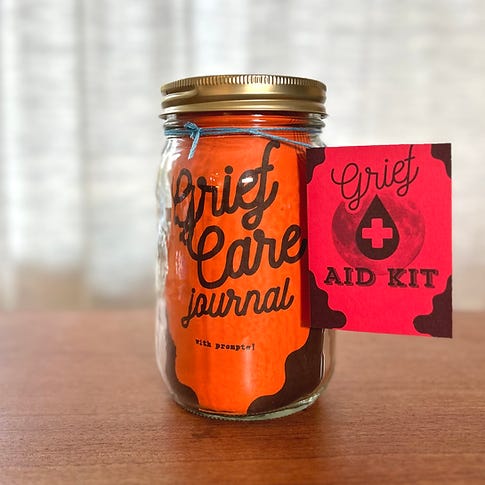
We have a chocolate bar in there, some hot cocoa, some tea bags, epsom salt, those little eye-depuffers for under the eye, because often we're finding ourselves crying a lot in the grief process. Tissues, and essential oil room spray that's just really lovely and calming.
It all fits into one of those Ball jars, the slightly big Ball jars. It's really neatly stuffed in there. And there's a grief journal in there. I forgot to mention that. So if you have a friend or someone who's grieving and you don't know what to get them, you can give them one of these.
It's just a really nice little package. And I designed it based on my favorite gifts that I got when my parents died. I remember my friend sent me a box with skincare stuff, and it had a whole bunch of those eye puffers in it. I was just like, this is the most brilliant thing anyone could have.
I had never even used those before. I had never even thought of those things. And I was like, this is the most brilliant thing anyone could have ever thought to give me, because this just feels so kind to myself to do this for myself right now. I thought through those different gifts that I got, and was like, yeah, I think this would be a really special thing to give to somebody who's grieving.
BW: That's nice that it's based on what you yourself got.
MJ: Yeah.
BW: That's a personal touch. Then you also have a ritual journal and a ritual kit. So what spirituality plays into these kits? And how does your own spirituality affect how you do that work?
MJ: Yeah, that's a great question. The kits are left pretty broad, and the ritual journal, of all the zines that we've made, is the most open-ended of all of them. That's on purpose.
I'll go into my spirituality a little bit. I was raised completely non-religious. I had a scientist mom who was a biologist at the university here for 50 years. She was not religious, and neither was my father.
We did the capitalism stuff, so we did stuff like that. But we didn't have any religion. So growing up, I was always fascinated with ghosts, and was pretty sure that I was experiencing ghost energy from a young age. And so my spirituality is just based on that experience of being thinking, “What is this? What is this? What are these vibes? What is this?” And then the dipping of my own toes in different things, like astrology, and tarot, and talking to psychics, and being an artist, and having these mystical interventions in my life. So that is my own personal spiritual background.
It's a piecemeal experience. When we put together something like a ritual kit, it just has your basics. It has some candles, some matches, a ritual journal that just allows you to just write what you're experiencing. There's an intro at the start of the journal just to acknowledge that you may be going through some grief if you're coming to this journal through us. I just like to acknowledge that in all of the zines.
This is a space for you, especially if you're going through some grief, and letting people know that Madison Death Collective is a resource for them if they're coming upon it. Maybe they were gifted our grief journal or something like that. I just like to make that clear. But then the ritual journal, it's all just pages with lines on it. It has a moon guide for 2025, so just showing the moon phases for 2025.
I would say anybody from many backgrounds could pick that up and start using it. Oh, it also comes in a mug and has the hot cocoa powder in it. So while you're doing your ritual, you can pour yourself this hot cocoa and light a candle and write.
And that in itself can be a ritual. It doesn't have to be this whole thing. It could just be that I'm sitting with the intention of tapping into my grief or tapping into whatever I'm experiencing right now.
BW: And you design and write all the zines yourself?
MJ: Yeah, I do.
BW: So what's something you learned during your training that surprised you and made you think, this is so obvious, why had we not thought of this before?
MJ: Okay, that is such a good question, and I could probably take this in a zillion ways. I think the thing that's been coming up for me lately is the thing I'm going to say. So Narinder, who led the training, she's amazing, first of all.
She's extremely knowledgeable about being a death midwife and working with dying people and their loved ones at the end of life. She talked a lot about death work not just being about sitting vigil with a dying loved one. Death work is about supporting the collective and collective grief, especially during this time in our history, where there is just endless amounts of destruction and pain and grief happening at a collective level.
Death work is about supporting the collective and collective grief, especially during this time in our history, where there is just endless amounts of destruction and pain and grief happening at a collective level.
Death workers are not just here to do that one thing. We are here to fill in all of these gaps. And my other cohort was in this apprenticeship with only one other student, which was unique. Usually, Narinder has more students in the class at one time.
But my other cohort buddy, she comes from a public health background, and she says that the unresolved grief that we have in our culture is essentially a public health crisis. Part of the role of a death worker in this society is to support people as we walk through the fall of this empire, the transformation of what it is to live in late capitalism or fascism or whatever it is that we can call this moment in time. Death workers are able to hold ourselves straight during this extreme moment of grief. We're not just there for that one thing. We're there for a lot of things.
BW: How do you see your own death work as supporting healing that collective grief?
MJ: I think that's why I'm so interested in pouring a lot of my time into the Madison Death Collective. I'll go back a little bit to what I was saying when I was introducing myself.
My background is in promoting artists. I mean, I am an artist myself, and my background is in being an artist, and my career background is in promoting artists. I was the director of an art gallery in Chelsea and promoted artists from all over the world.
I'm taking those skills now and applying them to promoting practitioners in the Madison area who are doing death and grief work. I can't do it all. No way. I can't sit vigil. I can't be a therapist. I can't do all of that. I can't be a natural burial practitioner. I would love to do all of those things if I had a million hours each day.
But what I can do is promote the people in the community who are doing that and create awareness amongst the folks who need or who may not even know that they need those resources and say, did you know that we have this?
We have somebody who does this, and this is how amazing they are, and how much of a support they can be. So I think that I'm using the skills that I have to lift up the people who can support the collective, too. I see that as part of my death work.
BW: Yeah, that's really beautiful. I like the transfer of those skills. That makes so much sense.
What advice would you give to someone who was trying to start something similar from scratch in another city?
MJ: Just do it. I just say, just do it. We need it. If your city doesn't have a collective yet, start one. If your city has a collective and you have a different idea for a different collective, start the different one, join the existing one.
I really come to this work with a spirit of abundance. If you feel called to do this work, then do it and find other people who want to do it. I don't feel like I've been doing this long enough to really know the pitfalls. I'm probably walking into a few right now, and I'll find them afterwards. Sometimes we just need to start and then learn as we go, and this work is needed.
BW: Have you had any pushback since starting, or were there people who are skeptical of the need for this?
MJ: Well, I'll say this, and this is fascinating. I also have done a few booths. Madison loves their makers markets and their craft fairs, and things like this. So I did a booth and set it up, and had the merch and had a little sign that said Madison Death Collective.
Around me are other booths of people selling ceramics and tapestries and things like that. And I had a number of people walk past the booth, side-eyeing the booth, and then looking at me like, “What is this?”
And then they would say, “What is a death collective?” And I would explain that we're a collective of practitioners who support the grieving and the bereaved and folks who are dying.
You could see their whole body relax. And then immediately they would be like, “Wow, okay. Okay, thank you. This is so cool.” Then they would start thumbing through the zines or looking at the grief jars, and being like, “Wow, actually, this is really needed.”
So I wouldn't say that I've had people who, once they learn about it, are skeptical, but I think sometimes people look at the name and they're like, “What the heck is that?” Which that's great. It's sparking curiosity.
BW: I wonder if they're sometimes just put off by the word death in general, and then you explain, and they say, “Oh, okay.”
MJ: Yeah. And I would say that as a culture, we are put off by the word death in general. And that's the point of having the word in the name, is that it's okay to say the word death. It doesn't sound the same to say “Madison Passed Away.”
BW: Well, my final question is, are you working on anything right now that you want to shout out or promote?
MJ: Oh, boy. We are working on a lot of things. Okay. Let me just think about where I want to take this, because we're actually working on a number of things I'm not quite sure I'm ready to shout out.
First of all, stay tuned because I do want to shout these things out. I just want to do it right. So stay tuned because there might be some more things to shout out soon. But we are going to be hosting the Weave & Grieves regularly, so I do want to say that.
If you're in Madison, then we would love to have you at those. If you're not in Madison, we would love to have you following what we do and what other death collectives do. Our future Weave & Grieves will be held at the East Morland Community Center, which is a cute little community Community Center on the East Side of Madison. We have just been invited to share space there, so we're really excited about that. And I'll just say this, that we plan to do more in collaboration with the community at the East Morland Community Center, too.
If you’re interested in being interviewed or promoting your projects, please reach out to me at kira (at) busywitch.com.
This interview has been transcribed and edited for clarity and conciseness. All mistakes are my own.
Submit your ideas!

Have something you want to share? Whether it’s a witchcraft-related secret, a new poem, a personal essay, or a wild short story, I want to take a look. Send me an email at kira (at) busywitch.com.